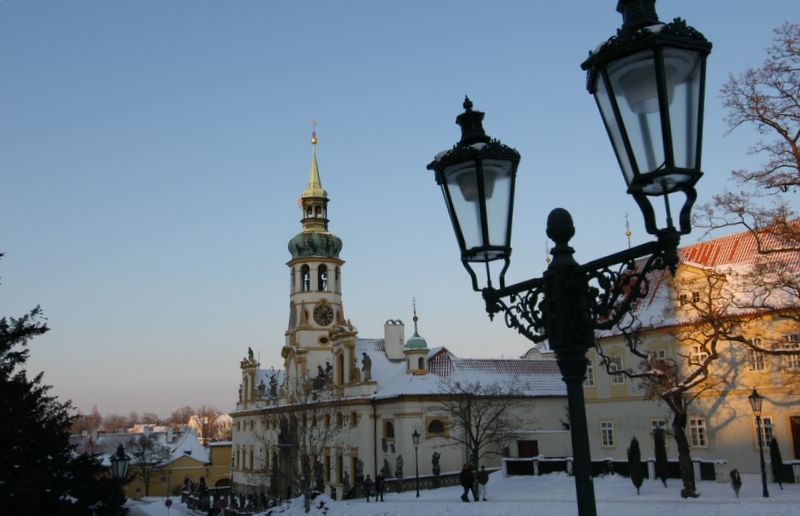
The origins of Bohemian Baroque architecture in the early-mid 17th Century can be traced to innovative Italian architects (such as Borromini) who were working with a much greater dynamic conception of space using intersecting ovoid (concave/convex) shapes and undulating, fluid facades. These architectural spaces are characterized by dramatic oppositional spaces, complex stacking of forms which gives the facades a dramatic formal tension, and a repetition of elements, such as windows, entablatures and columns, which lends a rhythmic balance to the theatrical spaces. This architecture was exported beyond Italy due to the winning by the Catholics of the religious Thirty Years War (1618 – 1648). Baroque Architecture was at the heart of the Catholic counter-reformation, an ambassador of Catholic power opposed to the simpler, less-monied styles of the Reformation churches. Its grandiosity suggested the power and pomp of the Church and the nobles who supported the Church, the majesty of it’s church’s interiors, symbolic of the link between the Church and heaven, the Pope being God’s representative on Earth. The so-called “radical” Baroque reached a pinnacle in Bohemia and Prague as it represented here even more forcefully the occupation of the victorious Catholics against the Protestants.
The forces of reformation against the Catholic Church have a strong history in the Czech lands. One hundred years before Martin Luther, in the early 1400’s, Jan Hus was martyred and his followers rebelled against the powers in Rome – many battles had ensued, and though the Czechs did have a few victories (under Jan Zizka at Vitkov Hill, for example) theirs was ultimately a peasant army against the trained soldiers of the Catholic Hapsburgs. The Hussites were run into hiding; but the ideas lingered on, and under the lenient rule of Rudolf at the beginning of the 1600’s, the Protestants and Hussites were allowed more tolerance. With Rudolf’s death in 1612, more militant Catholics held the reins of power in Prague and the Protestants were pushed into more open rebellion. This led to the Third Defenestration of Prague in 1618, the brief reign of the Palatinate Frederick II, and the beginning of the Thirty Years War. Bohemia was quickly defeated in the beginning of this war with the Battle of White Mountain of 1620, and the Hapsburgs, under Ferdinand the II quickly regained power in the region. The mercenary general Albrecht of Wallenstein, among many others, made fortunes from the sacking of the territories – and this money was funneled back into large architectural projects, both in Prague, and in outlying estates.